Home Blog

Gantt Chart Template Excel

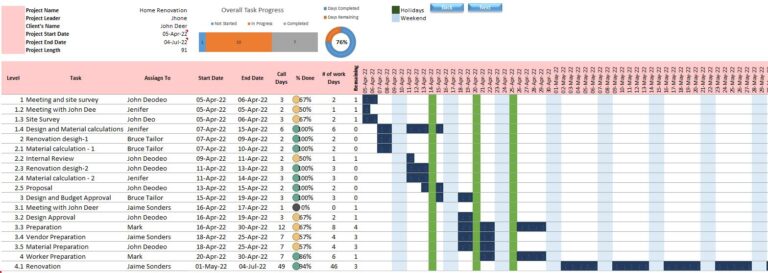
Project management is only as successful as your ability to track tasks, timelines, and responsibilities. Our Gantt Chart Excel Template is the perfect tool to help you visualize your project timeline, monitor progress, and keep your team aligned.

gantt chart template excelWhat’s Inside the Template?

The template is designed with four primary sheets, each serving a distinct purpose:

  1. Gantt Chart (Main Sheet)

    • Project Info Section: Includes fields for project name, project leader, client, start and end dates, and progress percentage.

    • Visual Timeline: Uses a day-by-day format to visualize tasks across the project duration.

    • Progress Tracker: Offers automated calculation for “Days Completed” to help you monitor ongoing efforts in real time.

  2. Settings

    • Holiday Settings: Customize your calendar to skip holidays or non-working days.

    • Assignment Dropdowns: Assign tasks by selecting team members from a list, improving ease and consistency.

  3. Dashboard (Currently empty)

    • This tab is reserved for dashboard visuals or summary metrics. You can customize this area to show graphs or KPIs like completion rates, upcoming tasks, or delays.

  4. Sheet1 (Status Overview)

    • Helps quickly summarize the number of tasks that are “Not Started,” “In Progress,” or “Completed.”

    • Useful for reporting and team briefings.

Key Features:

  • Simple & Customizable Layout: Whether you’re a beginner or an experienced PM, this template is easy to modify.

  • Progress Calculation: Automates percentage completed based on task timelines.

  • Holiday Adjustments: Avoids counting non-working days in task duration.

  • Color-Coded Bars: (Optional enhancement) Easily customize bars by task status for instant visual insights.

How to Use It:

  1. Enter Project Information: Set your start/end dates and define project parameters.

  2. List Tasks: Add each task, set start and end dates, and assign responsible team members.

  3. Track Progress: Update regularly to reflect completed tasks and view your timeline evolve.

Ideal For:

  • Project managers

  • Construction planning

  • Marketing campaigns

  • Event planners

  • Freelancers managing multiple clients

đź”— Download Now and Stay On Track

Ready to take control of your project timeline? Download our Gantt Chart Excel Template and get started instantly.

Download Now

RACI Matrix Template Excel

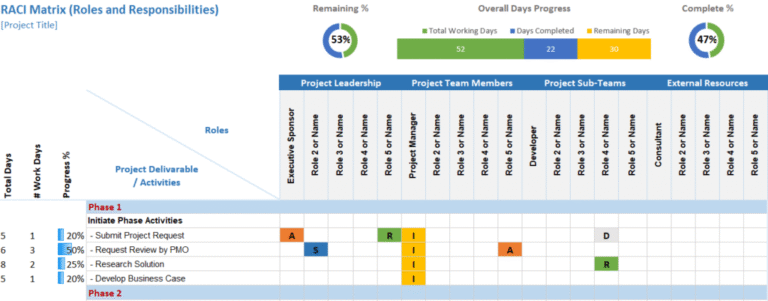
Navigating the complexities of project management can feel like steering a ship through foggy waters. With numerous tasks, responsibilities, and stakeholders involved, clarity is often hard to come by. This is where the RACI matrix shines as a beacon of light. Designed to enhance communication and streamline workflows, the RACI matrix helps teams define roles clearly and effectively.

But what exactly is a RACI matrix? It’s more than just an organizational chart; it’s a powerful tool that outlines who is Responsible, Accountable, Consulted, and Informed for each task or decision in your project. By using a RACI template in Excel, you can ensure everyone knows their role at every step of the way.

Curious about how this simple framework can transform your projects? Dive into this guide to discover its purpose, benefits, and practical tips on leveraging an Excel RACI template for maximum efficiency!

raci matrix template excelPurpose and Benefits of Using a Raci Matrix Template

A RACI matrix serves as a vital tool for clarifying roles and responsibilities within projects. By outlining who is Responsible, Accountable, Consulted, and Informed, teams can streamline communication.

Using a RACI matrix template enhances collaboration. Team members understand their specific duties at a glance. This clarity reduces confusion and helps prevent tasks from falling through the cracks.

Moreover, it promotes accountability. When everyone knows who is responsible for each task, it’s easier to track progress and address any issues that arise.

The template also aids in resource management. Properly assigning roles ensures optimal use of team strengths while minimizing overlaps in responsibility.

Additionally, having this structured approach fosters transparency across departments or project teams. It encourages open dialogue about expectations and deliverables among all stakeholders involved in the project.

How to Create a Raci Matrix in Excel

Creating a RACI matrix in Excel is straightforward. Start by opening a new spreadsheet.

Label the columns with project tasks or deliverables. Each task should have its own column to maintain clarity.

Next, create rows for each team member or stakeholder involved in the project. This layout will help visualize roles better.

In each cell, input the corresponding responsibility: Responsible, Accountable, Consulted, or Informed. Use initials to keep it concise.

Excel’s formatting tools can enhance readability. Consider using color coding for different responsibilities. This simple touch makes it easier to interpret who does what at a glance.

Don’t forget to save your template! Reusing it across projects saves time and maintains consistency in role assignment.

Tips for Using the Template Effectively

To make the most of your RACI matrix template, clarity is key. Clearly define roles and responsibilities for each task to prevent confusion. Ensure everyone understands their specific contributions.

Regularly update the matrix as projects evolve. This keeps it relevant and aligned with team dynamics or project scopes that may shift over time.

Encourage open communication among team members about their assigned tasks. Foster an environment where questions are welcomed; this helps avoid misinterpretations.

Visual appeal matters too! Use color coding to differentiate between Responsible, Accountable, Consulted, and Informed roles. A visually engaging matrix can enhance understanding at a glance.

Review the template as a group after completion of major milestones. Gathering feedback from all participants can lead to improvements in future iterations of the RACI matrix.

Examples and Use Cases of Raci Matrix Templates in Various Industries

RACI matrices are versatile tools used across diverse industries. In healthcare, for example, they clarify roles in patient care teams. This ensures everyone knows their responsibility during treatments and procedures.

In project management, the RACI matrix helps streamline communication among team members. By assigning specific tasks to individuals or groups, it minimizes confusion and enhances accountability.

The marketing sector benefits too. A RACI template can delineate who is responsible for content creation versus approvals in a campaign workflow. This structure encourages timely feedback and drives successful outcomes.

Manufacturing also leverages RACI matrices to define responsibilities on production lines. Clear role delineation improves efficiency and reduces errors during operations.

Educational institutions utilize these templates to outline duties among faculty when developing curricula or planning events. This organized approach fosters collaboration while ensuring that nothing falls through the cracks.

Common Mistakes to Avoid When Using a Raci Matrix Template

One common mistake when using a RACI matrix template is unclear role definitions. Ambiguity can lead to confusion among team members about their responsibilities. Each role—Responsible, Accountable, Consulted, Informed—should be well defined and understood.

Another pitfall is overcomplicating the matrix. Including too many tasks or roles can overwhelm users and dilute its effectiveness. Keep it simple for clarity.

Failing to update the RACI matrix regularly also poses challenges. As projects evolve, so do responsibilities. An outdated matrix can hinder progress rather than assist it.

Not involving key stakeholders in the creation process might result in resistance later on. Engaging everyone from the start fosters buy-in and ensures accountability across the board.

Conclusion and Resources for Finding Excel Raci Matrix Templates

The RACI matrix is a powerful tool that fosters clarity and accountability in project management. By defining roles and responsibilities, it streamlines communication within teams. Utilizing a RACI matrix template can enhance your workflow significantly.

When searching for Excel templates, numerous resources are available online. Websites such as Microsoft Office’s official site offer free downloadable templates that you can customize to meet specific project needs. Additionally, platforms like Smartsheet or Lucidchart provide user-friendly options tailored to various industries.

Remember to select a template that aligns with your team dynamics and project requirements. This approach ensures effective collaboration and minimizes confusion among team members. With the right RACI matrix excel template at hand, you’re well on your way to achieving greater productivity and success in your projects.
Project Portfolio Management (PPM)

Project Portfolio Management (PPM) is a centralized management process used to manage a group of projects and programs to achieve strategic business objectives. Here are some key components and templates that can be used to facilitate effective project portfolio management:

Key Components of PPM

  1. Portfolio Governance
    • Purpose: Establishes the framework for decision-making.
    • Contents: Governance structure, roles and responsibilities, decision-making criteria, and reporting mechanisms.
  2. Portfolio Planning
    • Purpose: Aligns projects with strategic objectives.
    • Contents: Project selection criteria, prioritization process, resource allocation, and risk assessment.
  3. Portfolio Performance Management
    • Purpose: Monitors and evaluates portfolio performance.
    • Contents: Key performance indicators (KPIs), performance reports, risk and issue logs, and change management processes.
  4. Resource Management
    • Purpose: Optimizes the use of resources across the portfolio.
    • Contents: Resource allocation, capacity planning, skills inventory, and resource utilization tracking.
  5. Financial Management
    • Purpose: Manages the financial aspects of the portfolio.
    • Contents: Budgeting, cost tracking, financial forecasting, and benefit realization.
  6. Risk Management
    • Purpose: Identifies and mitigates risks across the portfolio.
    • Contents: Risk registers, risk assessment matrix, risk response plans, and risk monitoring.
  7. Stakeholder Management
    • Purpose: Engages and communicates with stakeholders.
    • Contents: Stakeholder identification, communication plans, and feedback mechanisms.

Essential PPM Templates

  1. Portfolio Charter Template
    • Purpose: Authorizes and defines the portfolio.
    • Contents: Portfolio objectives, scope, governance structure, and high-level plans.
  2. Project Selection Criteria Template
    • Purpose: Establishes criteria for selecting projects.
    • Contents: Strategic alignment, benefits, costs, risks, and resource requirements.
  3. Portfolio Roadmap Template
    • Purpose: Provides a visual timeline of the portfolio.
    • Contents: Key projects, milestones, dependencies, and timelines.
  4. Resource Allocation Template
    • Purpose: Manages the distribution of resources.
    • Contents: Resource availability, allocation across projects, and capacity planning.
  5. Financial Tracking Template
    • Purpose: Monitors financial performance.
    • Contents: Budget, actual costs, variance, and financial forecasts.
  6. Risk Register Template
    • Purpose: Identifies and tracks risks.
    • Contents: Risk descriptions, likelihood, impact, mitigation strategies, and risk owners.
  7. Performance Dashboard Template
    • Purpose: Provides a snapshot of portfolio performance.
    • Contents: KPIs, project status, resource utilization, and financial performance.
  8. Issue Log Template
    • Purpose: Tracks and manages issues.
    • Contents: Issue descriptions, impact, resolution strategies, and status.
  9. Stakeholder Communication Plan Template
    • Purpose: Defines communication strategies.
    • Contents: Stakeholder analysis, communication methods, frequency, and responsibilities.
  10. Benefit Realization Plan Template
    • Purpose: Ensures benefits are delivered.
    • Contents: Expected benefits, benefit owners, measurement criteria, and tracking mechanisms.
  11. Change Management Plan Template
    • Purpose: Manages changes within the portfolio.
    • Contents: Change request process, approval procedures, impact analysis, and change logs.
  12. Portfolio Status Report Template
    • Purpose: Regularly updates stakeholders on portfolio status.
    • Contents: Project updates, performance metrics, issues, risks, and upcoming milestones.
  13. Project Prioritization Matrix Template
    • Purpose: Prioritizes projects based on strategic criteria.
    • Contents: Scoring criteria, project scores, and prioritization results.
  14. Lessons Learned Template
    • Purpose: Captures insights and improvements.
    • Contents: Lessons learned, best practices, and recommendations for future projects.
  15. Portfolio Closure Report Template
    • Purpose: Formally closes the portfolio.
    • Contents: Summary of portfolio performance, final deliverables, lessons learned, and documentation archive.

By utilizing these templates and components, organizations can effectively manage their project portfolios, ensuring alignment with strategic goals, optimal use of resources, and improved overall performance.

Business Management Templates

Here are essential business management templates that can help streamline and enhance various aspects of business operations:

1. Business Plan Template

  • Purpose: Outlines the business’s strategy and goals.
  • Contents: Executive summary, company description, market analysis, organization and management, product line, marketing and sales strategies, funding request, and financial projections.

2. SWOT Analysis Template

  • Purpose: Identifies strengths, weaknesses, opportunities, and threats.
  • Contents: Sections for listing and analyzing each aspect to help in strategic planning.

3. Market Research Template

  • Purpose: Gathers and analyzes market data.
  • Contents: Market size, growth trends, target market, competitor analysis, and customer insights.

4. Financial Plan Template

  • Purpose: Details financial strategy and projections.
  • Contents: Income statement, balance sheet, cash flow statement, break-even analysis, and financial ratios.

5. Budget Template

  • Purpose: Plans and tracks business finances.
  • Contents: Revenue projections, expense estimates, profit margins, and budget comparisons.

6. Business Model Canvas Template

  • Purpose: Visualizes the business model.
  • Contents: Key partners, activities, value propositions, customer relationships, customer segments, channels, cost structure, and revenue streams.

7. Project Management Template

  • Purpose: Plans and manages business projects.
  • Contents: Project charter, project plan, work breakdown structure (WBS), Gantt chart, risk management plan, and project status reports.

8. Sales Forecast Template

  • Purpose: Predicts future sales performance.
  • Contents: Monthly/quarterly sales projections, historical sales data, and growth rate assumptions.

9. Marketing Plan Template

  • Purpose: Outlines marketing strategies and tactics.
  • Contents: Market analysis, target audience, marketing goals, marketing mix (4 Ps), budget, and performance metrics.

10. Customer Relationship Management (CRM) Template

  • Purpose: Manages customer interactions and data.
  • Contents: Customer contact information, interaction history, sales pipeline, and customer feedback.

11. Operational Plan Template

  • Purpose: Details daily operations and processes.
  • Contents: Operational goals, process workflows, resource requirements, and performance measures.

12. Employee Handbook Template

  • Purpose: Communicates company policies and procedures.
  • Contents: Company culture, employment policies, code of conduct, benefits, and disciplinary procedures.

13. Job Description Template

  • Purpose: Defines roles and responsibilities.
  • Contents: Job title, duties, qualifications, skills required, and reporting structure.

14. Performance Review Template

  • Purpose: Evaluates employee performance.
  • Contents: Performance objectives, evaluation criteria, employee self-assessment, and manager feedback.

15. Meeting Agenda Template

  • Purpose: Structures business meetings.
  • Contents: Meeting objectives, agenda items, time allocations, and action items.

16. Strategic Plan Template

  • Purpose: Guides long-term business direction.
  • Contents: Vision and mission statements, strategic goals, action plans, and performance monitoring.

17. Risk Management Template

  • Purpose: Identifies and mitigates business risks.
  • Contents: Risk assessment, risk response strategies, and monitoring plans.

18. Customer Feedback Template

  • Purpose: Collects and analyzes customer feedback.
  • Contents: Survey questions, feedback collection methods, and analysis tools.

19. Supplier Management Template

  • Purpose: Manages supplier relationships.
  • Contents: Supplier contact information, contract details, performance metrics, and communication logs.

20. Training Plan Template

  • Purpose: Develops employee skills and knowledge.
  • Contents: Training objectives, curriculum, schedule, and evaluation methods.

These templates can significantly enhance efficiency, organization, and strategic planning within your business, helping to ensure smoother operations and better decision-making.

20 Must have Project Management Templates

Here are 20 must-have project management templates that can help ensure the smooth execution and completion of your projects:

1. Project Charter Template

  • Purpose: Authorizes the project and provides an overview.
  • Contents: Project objectives, scope, stakeholders, budget, and timeline.

2. Project Plan Template

  • Purpose: Details how the project will be executed, monitored, and controlled.
  • Contents: Scope, schedule, budget, risk management, and communication plans.

3. Work Breakdown Structure (WBS) Template

  • Purpose: Breaks down the project into manageable tasks.
  • Contents: Hierarchical decomposition of tasks and deliverables.

4. Gantt Chart Template

  • Purpose: Visualizes the project schedule.
  • Contents: Tasks, durations, dependencies, and milestones.

5. Risk Management Plan Template

  • Purpose: Identifies and mitigates potential risks.
  • Contents: Risk identification, assessment, mitigation strategies, and monitoring.

6. Stakeholder Register Template

  • Purpose: Identifies all stakeholders and their interests.
  • Contents: Stakeholder names, roles, interests, and communication requirements.

7. Communication Plan Template

  • Purpose: Ensures effective communication throughout the project lifecycle.
  • Contents: Communication methods, frequency, and responsibilities.

8. Resource Management Plan Template

  • Purpose: Details how resources will be managed.
  • Contents: Resource identification, roles, responsibilities, and allocation.

9. Quality Management Plan Template

  • Purpose: Ensures the project meets quality standards.
  • Contents: Quality objectives, assurance, and control activities.

must have project templates

10. Procurement Management Plan Template

  • Purpose: Manages procurement processes.
  • Contents: Procurement processes, supplier management, and contract administration.

11. Project Budget Template

  • Purpose: Estimates and controls financial resources.
  • Contents: Detailed budget estimates, funding sources, and cost control measures.

12. Change Management Plan Template

  • Purpose: Manages changes to the project scope, schedule, and budget.
  • Contents: Change request processes, approval procedures, and documentation.

13. Issue Log Template

  • Purpose: Tracks and resolves project issues.
  • Contents: Issue description, impact, owner, status, and resolution actions.

14. Project Status Report Template

  • Purpose: Provides updates on project progress.
  • Contents: Progress updates, accomplishments, issues, risks, and next steps.

15. Project Closure Report Template

  • Purpose: Formally closes the project and captures lessons learned.
  • Contents: Final project performance, deliverable acceptance, lessons learned, and documentation archive.

16. Meeting Minutes Template

  • Purpose: Documents meeting discussions and decisions.
  • Contents: Agenda, attendees, discussion points, decisions, and action items.

17. Project Timeline Template

  • Purpose: Provides a visual overview of the project schedule.
  • Contents: Key milestones, deadlines, and phases.

18. Project Scope Statement Template

  • Purpose: Defines the project scope and deliverables.
  • Contents: Project objectives, deliverables, boundaries, and acceptance criteria.

19. Milestone Chart Template

  • Purpose: Highlights key project milestones.
  • Contents: Milestone descriptions, dates, and dependencies.

20. Project Schedule Template

  • Purpose: Details the project timeline and activities.
  • Contents: Task list, start and end dates, durations, and dependencies.

These templates provide a structured approach to project management, ensuring that all critical aspects of the project are planned, executed, monitored, and documented effectively.

Importance of Project Documents

Project management documents are crucial for the success of any project due to the following reasons:

1. Clear Objectives and Scope

  • Definition: They clearly define the project’s objectives and scope, ensuring that everyone involved understands what needs to be achieved.
  • Benefit: Helps prevent scope creep and keeps the project focused on its goals.

2. Structured Planning

  • Definition: These documents provide a structured approach to planning, detailing the steps needed to complete the project.
  • Benefit: Ensures that all aspects of the project are considered and planned for, reducing the likelihood of unforeseen issues.

3. Effective Communication

  • Definition: Communication plans and stakeholder registers ensure that information is shared efficiently among all parties.
  • Benefit: Improves collaboration and reduces misunderstandings and miscommunication.

importance of project documents

4. Risk Management

  • Definition: Risk management plans identify potential risks and outline strategies to mitigate them.
  • Benefit: Helps in anticipating issues and planning responses, reducing the impact of risks on the project.

5. Resource Allocation

  • Definition: Resource management plans detail how resources (human, financial, etc.) will be allocated and managed.
  • Benefit: Ensures that resources are used efficiently and are available when needed, avoiding delays and cost overruns.

6. Quality Assurance

  • Definition: Quality management plans outline the quality standards and how they will be met.
  • Benefit: Ensures that the project’s outputs meet the required standards, leading to higher customer satisfaction.

7. Time Management

  • Definition: Schedules and Gantt charts provide a timeline for project activities.
  • Benefit: Helps in tracking progress and ensuring that the project stays on schedule.

8. Financial Control

  • Definition: Project budgets provide a financial framework and control measures.
  • Benefit: Ensures that the project stays within its financial limits and that costs are managed effectively.

9. Change Management

  • Definition: Change management plans outline how changes to the project will be handled.
  • Benefit: Provides a structured approach to managing changes, ensuring they are documented, reviewed, and approved appropriately.

10. Accountability and Tracking

  • Definition: Issue logs, status reports, and closure reports track project progress and document issues and resolutions.
  • Benefit: Enhances accountability and provides a record of project decisions and changes, facilitating better management and future project planning.

11. Formal Authorization

  • Definition: Documents like the project charter provide formal authorization to start the project.
  • Benefit: Establishes the project’s legitimacy and secures commitment from stakeholders and team members.

12. Lessons Learned

  • Definition: Project closure reports capture lessons learned and best practices.
  • Benefit: Provides valuable insights for future projects, improving processes and outcomes over time.

Overall, project management documents ensure that a project is well-organized, efficiently executed, and properly monitored, leading to higher chances of success and delivering value to stakeholders.

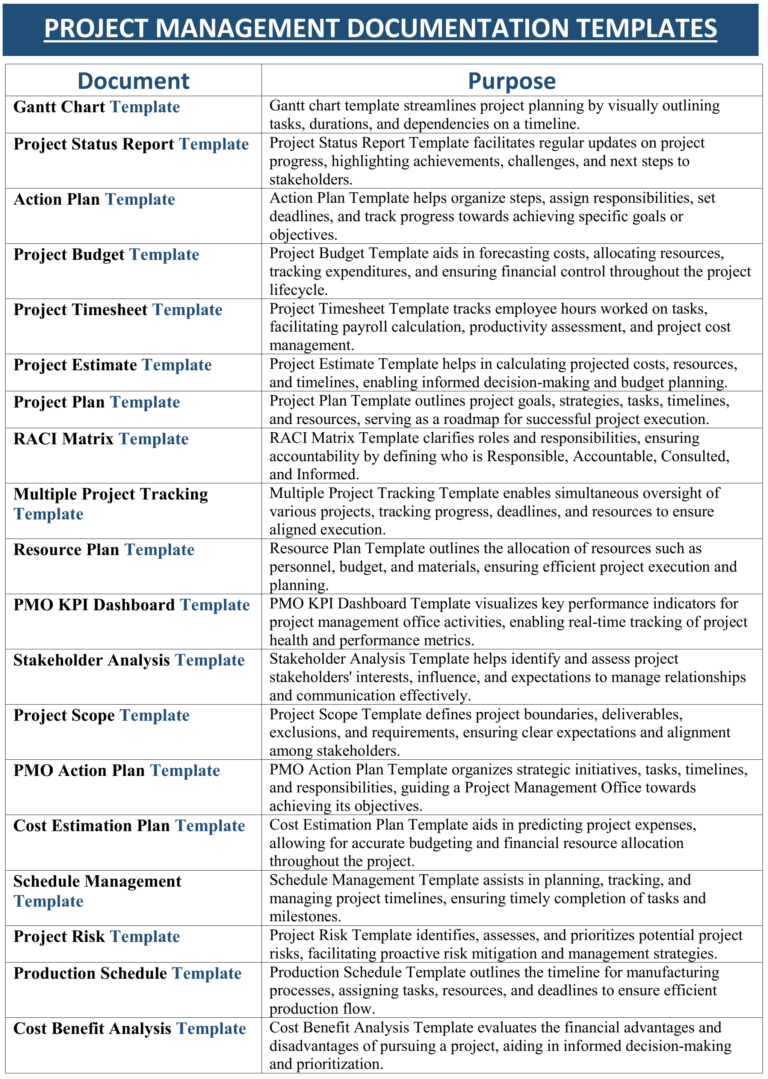
Project Management Documents

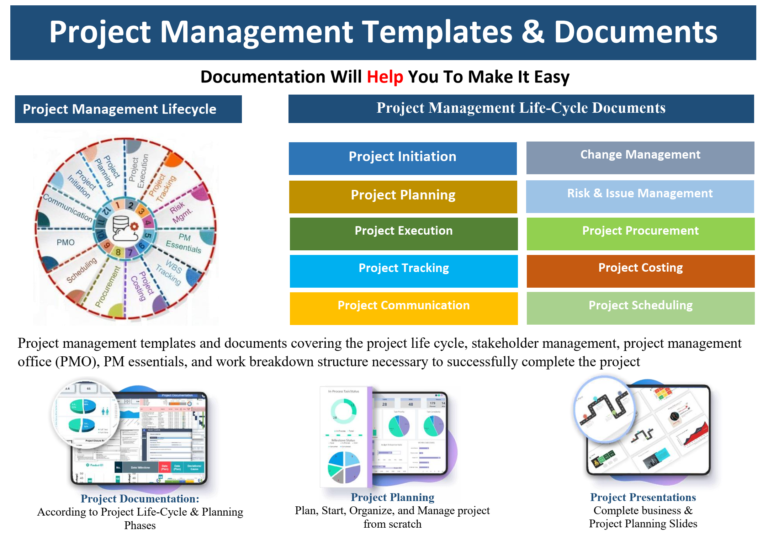
Project management documents are essential for the effective planning, execution, and completion of a project. Here is a list of key project management documents you might need:

1. Project Charter

  • Purpose: Officially authorizes the project and provides a high-level overview.
  • Contents: Project purpose, objectives, scope, deliverables, stakeholders, budget, and timelines.

2. Project Plan

  • Purpose: Provides a detailed plan on how the project will be executed, monitored, and controlled.
  • Contents: Project scope, schedule, budget, quality management, resource management, risk management, and communication plans.

3. Work Breakdown Structure (WBS)

  • Purpose: Breaks down the project into smaller, manageable components.
  • Contents: Hierarchical decomposition of the total scope of work.

4. Gantt Chart

  • Purpose: Visualizes the project schedule.
  • Contents: Tasks, durations, dependencies, and milestones.

5. Risk Management Plan

  • Purpose: Identifies potential risks and outlines mitigation strategies.
  • Contents: Risk identification, analysis, response planning, and monitoring.

6. Stakeholder Register

  • Purpose: Identifies all stakeholders and their interests.
  • Contents: Stakeholder names, roles, interests, and communication requirements.

7. Communication Plan

  • Purpose: Ensures effective communication throughout the project lifecycle.
  • Contents: Communication methods, frequency, and responsibilities.

8. Resource Management Plan

  • Purpose: Details how resources will be acquired, allocated, and managed.
  • Contents: Resource identification, roles and responsibilities, and resource allocation.

9. Quality Management Plan

  • Purpose: Ensures the project meets the defined quality standards.
  • Contents: Quality objectives, quality assurance, and quality control activities.

10. Procurement Management Plan

  • Purpose: Details how procurement will be managed.
  • Contents: Procurement processes, supplier management, and contract administration.

project management documents

11. Project Budget

  • Purpose: Estimates the financial resources required.
  • Contents: Detailed budget estimates, funding sources, and cost control measures.

12. Change Management Plan

  • Purpose: Manages changes to the project scope, schedule, and budget.
  • Contents: Change request processes, approval procedures, and change control board.

13. Issue Log

  • Purpose: Tracks and manages issues that arise during the project.
  • Contents: Issue description, impact, owner, status, and resolution actions.

14. Project Status Reports

  • Purpose: Communicates the current status of the project to stakeholders.
  • Contents: Progress updates, accomplishments, issues, risks, and next steps.

15. Project Closure Report

  • Purpose: Formally closes the project and captures lessons learned.
  • Contents: Final project performance, deliverable acceptance, lessons learned, and project documentation archive.

Each of these documents plays a crucial role in ensuring that the project is well-planned, executed, and monitored.